
Your A1C (also written HbA1c or glycated hemoglobin) is the single most important number for understanding your long-term blood sugar control. It tells you and your doctor what your average glucose has looked like over the past two to three months — not just today, not just this morning. This guide explains exactly what A1C is, how the test works, what your number means, how often you should test, and the evidence-backed strategies that move it.

What A1C Actually Measures
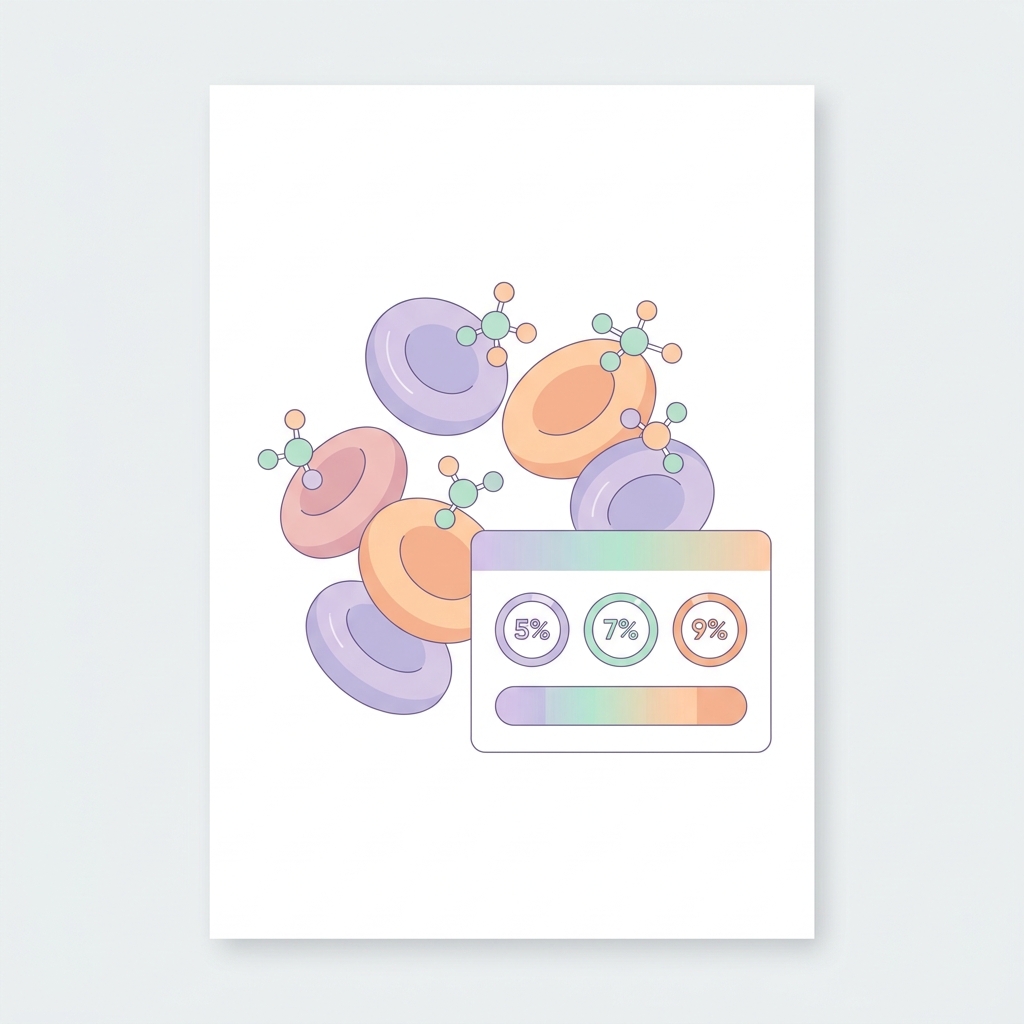
Unlike a single fingerstick reading that captures a moment in time, A1C looks at the percentage of your red blood cells whose hemoglobin has glucose stuck to it. Red blood cells live about 120 days, so the test gives a rolling 2–3 month average. The higher your average blood sugar, the more hemoglobin gets glycated, and the higher your A1C number.
The “A1C” name refers to a specific form of adult hemoglobin (HbA1c). When glucose circulates in your blood, some of it binds non-enzymatically to hemoglobin in a process called glycation. The A1C test measures the percentage of hemoglobin molecules that carry this glucose attachment. According to the CDC, this percentage closely tracks your average blood sugar over the lifespan of those red blood cells.
A1C vs. Fingerstick Glucose: What’s the Difference?
| Feature | A1C | Fingerstick / fasting glucose |
|---|---|---|
| Time window | 2–3 months (average) | Single moment in time |
| Requires fasting | No | Yes (for fasting glucose) |
| Frequency | Every 3–6 months | Daily or several times per day |
| Used for diagnosis | Yes | Yes |
| Affected by recent meals | No | Yes |
| Influenced by anemia | Yes | No |
Both tests have a role. Daily fingerstick or CGM readings tell you how you’re responding to this meal, this dose, this walk. A1C tells you whether all those daily decisions are adding up over time. For deeper comparison, see our A1C vs. fasting glucose breakdown.
A1C Levels Chart: What Your Number Means
| A1C | Estimated Average Glucose (mg/dL) | Classification |
|---|---|---|
| Below 5.7% | Below 117 | Normal |
| 5.7% – 6.4% | 117 – 137 | Prediabetes |
| 6.5% – 7.0% | 140 – 154 | Diabetes — well-controlled |
| 7.1% – 8.0% | 157 – 183 | Diabetes — moderate control |
| 8.1% – 9.0% | 186 – 212 | Diabetes — poor control |
| Above 9.0% | Above 212 | Diabetes — very poor control |
The American Diabetes Association recommends an A1C target of below 7.0% for most non-pregnant adults with diabetes. Some patients with new diagnosis, long life expectancy, or no significant cardiovascular disease may aim for below 6.5%. Older adults or those with multiple comorbidities may target 7.5–8.0% to balance hypoglycemia risk.
You can convert any A1C value to its corresponding estimated average glucose (eAG) instantly using our A1C-to-eAG calculator. For a more visual reference, see the full A1C levels chart by age.
How Often Should You Test Your A1C?
- Twice a year if your A1C is stable, you have type 2 diabetes, and you’re meeting your targets
- Four times a year (every 3 months) if your therapy has changed recently or you’re not meeting your targets
- Once a year minimum for anyone with prediabetes
- Every 3 years from age 35 as part of routine screening if you have no risk factors
- More frequently during pregnancy or in the months following diagnosis
What Affects the Accuracy of Your A1C?
A1C is reliable for most people, but a few medical conditions can produce misleadingly high or low readings:
- Anemia (low red blood cell count) or recent blood loss — can make A1C falsely low
- Hemoglobin variants like sickle cell trait or thalassemia — can interfere with the assay
- Kidney disease — especially advanced CKD, can alter red blood cell lifespan
- Pregnancy — second and third trimester red blood cell turnover is faster
- Recent blood transfusion — introduces donor hemoglobin not reflective of your glucose
- Iron-deficiency anemia — can make A1C falsely high
If your A1C and your daily glucose readings don’t match what you’d expect, ask your doctor about ordering a fructosamine test or continuous glucose monitor (CGM) data for a second perspective.
How to Lower Your A1C
Roughly speaking, every 1% reduction in A1C lowers the risk of diabetes complications (eye, kidney, nerve) by about 20–40% based on the landmark UKPDS trial. The good news: A1C is highly responsive to lifestyle changes within 90 days — the exact lifespan of the red blood cells the test measures.
The four highest-impact moves, in order of typical effect size:
- Diet quality — lower glycemic load, more fiber, more protein. See our guide to foods that lower A1C.
- Weight loss — even a 5–7% body weight reduction can drop A1C by 0.5–1.0 percentage points
- Exercise — 150 minutes moderate aerobic + 2×/week resistance training is the ADA recommendation
- Sleep + stress — chronic short sleep and elevated cortisol both push glucose up independently of diet
For the complete evidence-based playbook, see How to Lower Your A1C Naturally. Medications — metformin, GLP-1 receptor agonists like Ozempic, SGLT-2 inhibitors — can drive A1C down further when lifestyle alone isn’t enough. Always make medication decisions with your doctor.
Frequently Asked Questions
What is a normal A1C level?
A normal A1C is below 5.7%. 5.7–6.4% is classified as prediabetes, and 6.5% or higher on two separate tests confirms a diagnosis of diabetes, per CDC and ADA criteria.
Can you have diabetes with a normal A1C?
It’s rare but possible. A1C can be falsely lowered by anemia, recent blood loss, or certain hemoglobin variants. If your fasting glucose is consistently high but A1C is normal, your doctor may order a fructosamine test or CGM monitoring.
How quickly can A1C change?
Because A1C reflects the past 2–3 months of blood sugar, you generally won’t see dramatic shifts in less than 6–8 weeks. Most people see meaningful change at the 3-month re-test after a sustained lifestyle or medication adjustment.
Is A1C the same as eAG?
A1C and eAG (estimated average glucose) measure the same underlying thing but in different units. A1C is a percentage; eAG is a mg/dL or mmol/L value. You can convert between them with our A1C-to-eAG calculator.

Does fasting affect A1C results?
No. Unlike a fasting glucose test, A1C does not require you to fast before the blood draw because it measures average glucose over months, not your level at that moment.
Sources & Further Reading
- CDC — All About Your A1C
- NIDDK — The A1C Test & Diabetes
- American Diabetes Association — A1C and Diabetes
- Mayo Clinic — A1C Test
- UKPDS Trial Group — Intensive blood-glucose control with sulphonylureas or insulin